

You cut back on lollies years ago, you brush twice a day, and a new spot still turns up on the X-ray. That is a common enough story to be worth explaining.
The connection between sugar and rotten teeth depends far less on quantity than you might expect. The same amount of sugar across a week can leave one mouth healthy and another with new decay. If a recent check-up and clean found decay you had not noticed, what follows is usually where the difference lies.
Quick Overview
- Tooth decay happens when bacteria in plaque turn sugar into acid, and repeated acid attacks break down tooth enamel.
- How often sugar reaches your teeth matters more than how much you eat in one sitting.
- Free sugars include added sugars and those in syrups, and they appear on labels under a long list of other names.
- Fluoride toothpaste, daily flossing and regular check-ups reduce the damage sugar can do.
The sections below cover the mechanism, why frequency matters, which sugars count, and what protects teeth.
How does sugar cause tooth decay?
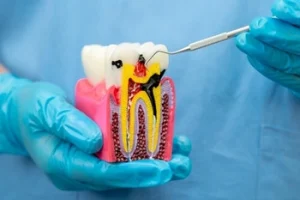 Plaque is a layer of bacteria that forms on teeth daily. Those bacteria change sugar into acid, and the acid attacks tooth enamel, the hard outer layer of the tooth.
One acid attack does not cause a cavity. Many attacks over time break the enamel layer down, and the first visible sign is often a white spot, not a hole. Left alone, that damage deepens into a cavity and reaches the softer tissue inside the tooth.
This is common. In Australia, 1 in 3 adults over 15 has untreated tooth decay.
Why how often you eat sugar matters more than how much
Each time sugar reaches your teeth, plaque produces another burst of acid, and saliva needs time to neutralise it. Constant snacking gives it no chance to catch up.
Frequent snacking exposes teeth to more acid, which is why structured meal and snack times protect teeth better than an open kitchen all afternoon. Sticky foods make it worse again, because spreads, dried fruit and muesli bars cling to tooth surfaces for hours and stretch each acid attack out.
A sweet treat with a meal is therefore easier on teeth than the same treat picked at across the afternoon. Set snack times do more for a child’s teeth than banning sugary foods outright.
Which sugars count, and where they hide
Added sugar goes into food during processing or at the table. Free sugars include added sugars plus those in syrups. Natural sugars are already present in whole foods such as vegetables, fruit and milk.
Natural and added sugars affect teeth in much the same way. The difference is what comes with them: fruit and milk carry fibre, vitamins and minerals, and milk also contains calcium, which helps protect teeth. Heavily sweetened packaged foods bring little else.
So how much sugar is too much sugar? The daily figure recommended for adults is six teaspoons of free sugar, about 24 grams, set to reduce the risk of tooth decay and of the weight gain linked with obesity. One can of soft drink averages 10 teaspoons on its own.
On nutrition labels, the 100-gram column is the one to use, since serving sizes differ between products, and under 5 grams of sugar per 100 grams is the range to aim for.
Sugar also appears under a long list of names, which is what makes hidden sugars hard to spot. Ingredients are listed in order of quantity, so anything sugar-related near the top is present in bulk.
How to protect your teeth without giving up every treat
Brushing twice a day with fluoride toothpaste does the most work, alongside flossing once a day. After brushing, spit the toothpaste out and skip the rinse, which leaves a thin fluoride layer on the tooth surfaces for extra protection.
Plain water is the drink that does teeth the most good, and most Australian tap water is fluoridated. Soft drinks, sports drinks and fruit juices all sit at the other end of that scale. A glass of water after something sweet helps clear the sugar away, and cheese or chopped raw vegetables make useful snacks because they need chewing, which gets saliva moving.
Good oral hygiene will not undo a constant sugar supply, but brushing teeth properly twice a day keeps plaque from building up. Regular check-ups matter too, because early decay causes no symptoms. Treating white spots is a smaller job than filling cavities, and poor oral health is separately associated with chronic conditions including heart disease.
 Talk to The Smile Artisans about protecting your teeth
 Talk to The Smile Artisans about protecting your teeth
Decay is easier to manage early, and early decay is not something you can see or feel at home. At The Smile Artisans, our friendly team examines your teeth for the early white-spot changes that appear before a cavity forms. If diet is part of the picture, we will talk it through with you. An examination is a straightforward place to start, particularly if it has been a while since your last visit. To arrange a check-up, please call us on 02 9000 1297 today.
Frequently Asked Questions
Do children’s teeth decay faster than adult teeth?
Yes. The enamel on baby teeth is thinner and softer than on adult teeth, so decay moves through it faster. That is why a child’s first dental visit should not wait for a problem to appear.
Can early tooth decay be reversed?
Early decay can be stopped, and sometimes reversed, before a cavity forms. At the white-spot stage, fluoride paste or varnish applied in the chair, with better brushing and less added sugar, can halt it. Once a hole has formed, a filling is needed.
Is honey better for teeth than table sugar?
No. Honey is classified as a free sugar, so as far as the bacteria in plaque are concerned, it behaves like any other sugar. It is also sticky, which keeps it against the tooth for longer than something that clears quickly.
Will cutting out sugar completely stop decay?
It lowers the risk but does not remove it. Plaque bacteria can also use the carbohydrates in bread, crackers and chips, so decay can develop on a low-sugar diet if brushing and flossing slip.
Does 100 per cent fruit juice count as added sugar?
It counts as free sugar, which is the category that matters for teeth. Juicing releases the sugar and leaves the fibre behind, so juice reaches teeth differently from whole fruit.
References
https://www.healthywa.wa.gov.au/Articles/S_T/Tooth-decay-and-gum-disease
https://raisingchildren.net.au/babies/health-daily-care/dental-care/tooth-decay